

Spotting Overtraining in Young Athletes: Key Signs to Know
December 01, 2025
13 min
Ever watch your kid take a giant gulp from the water bottle right before they run onto the field and think, “Job done”? Or maybe you’ve packed the same go-to snack for years because it’s easy and they don’t complain. I get it. We’re all just trying to get through the week without forgetting a cleat or a practice jersey. But what if that last-minute chug of water is barely making a dent? And what if that trusty granola bar is secretly working against them before the game even starts?
Let’s talk about what we’re really trying to do here. We’re not just filling a water bottle; we’re trying to fuel a body that’s about to push its limits. And the stuff we’ve heard for years—“drink eight glasses a day,” “just listen to your thirst”—starts to fall apart when you’re staring at a kid who’s about to play four innings in 90-degree heat. The truth is, hydration is a strategy, not a reaction. And the snacks we choose are the first step in that plan, for better or worse.
Think about it like this: you wouldn’t roll your car up to a race with the gas light on, right? You’d fill up the tank well before the starting line. Our young athletes, though? They’re often starting their engines with the needle hovering near “E,” and we’re handing them a sippy cup of fuel mid-race.
The research is pretty clear on this. One study had guys cycling in the heat with different drink plans: nothing, plain water, or an isotonic mix. The ones who got the balanced drink—the one with some carbs and sodium—did a whole lot better. Their bodies didn’t have to work as hard to keep cool, and their heart rates stayed more manageable. Plain water was good, but it wasn’t as good. No drink at all was a straight-up disaster.
This knocks a big hole in the “drink when you’re thirsty” idea, at least for scheduled stuff. By the time a kid feels that dry-mouth thirst on a hot day, they’re already behind. That study from the high school cross country teams drives this home. The runners who were properly hydrated had lower body temps, felt like the run was easier, and even thought more clearly than the ones who were running on low fluids. Their brains worked better. That’s not just a performance thing; that’s a safety thing.
So, what’s the plan? Ditch the idea of hydration as something you do at the field. It starts at breakfast. It’s about “pre-loading.” Offering water or milk consistently throughout the school day is the mission. The goal is to send them to practice or a game already in a good place, not trying to dig out of a hole with a 16-ounce bottle.
Alright, let’s tackle the snack bag. This is where we can shoot ourselves in the foot without even knowing it. We grab something labeled “energy” or “protein” and think we’ve nailed it. But some of these classic picks are like pouring sugar-sand into a finely tuned engine.
Take the average fruit snack or that big, chewy granola bar. (You know the ones—they might as well be glued to the roof of your mouth). What are they, really? They’re often little more than concentrated sugar hits, sometimes with a dusting of vitamins to make us feel better about buying them. Here’s the problem with that sugar bomb right before exertion: it can cause a quick spike in blood sugar, followed by a nasty crash right when you need steady energy. Even worse, that high concentration of sugar pulling into the gut can actually slow down how fast water gets absorbed. You’re giving them fluid, but you’re also giving them something that makes it harder for the body to use that fluid efficiently.
And those fancy ”sports drinks” that look like a neon light show in a bottle? If your kid’s just having a one-hour practice, they’re probably overkill. That study on the cyclists showed the benefit of the isotonic drink—which is basically a well-formulated sports drink—in tough, sustained heat. For a shorter, less intense effort, that extra sugar and sodium isn’t doing much except maybe upsetting a stomach. Water is perfect. Save the electrolyte drink for the marathon tournament days with back-to-back games, where they’re losing real sweat and need the carb boost to keep going.
The aim for a pre-game snack isn’t to be a full meal. It’s to top off the tank without causing a traffic jam. You want something with digestible carbs, a little protein or fat to smooth out the energy release, and not too much bulk or fiber that’ll sit in their gut like a brick. A banana with a small swipe of peanut butter, some applesauce and a handful of pretzels, or half a plain bagel with some cheese—simple, real food tends to win this race every time.
This doesn’t have to be rocket science. In fact, the best plans are the simple ones that you can actually remember at 5 PM on a Tuesday.
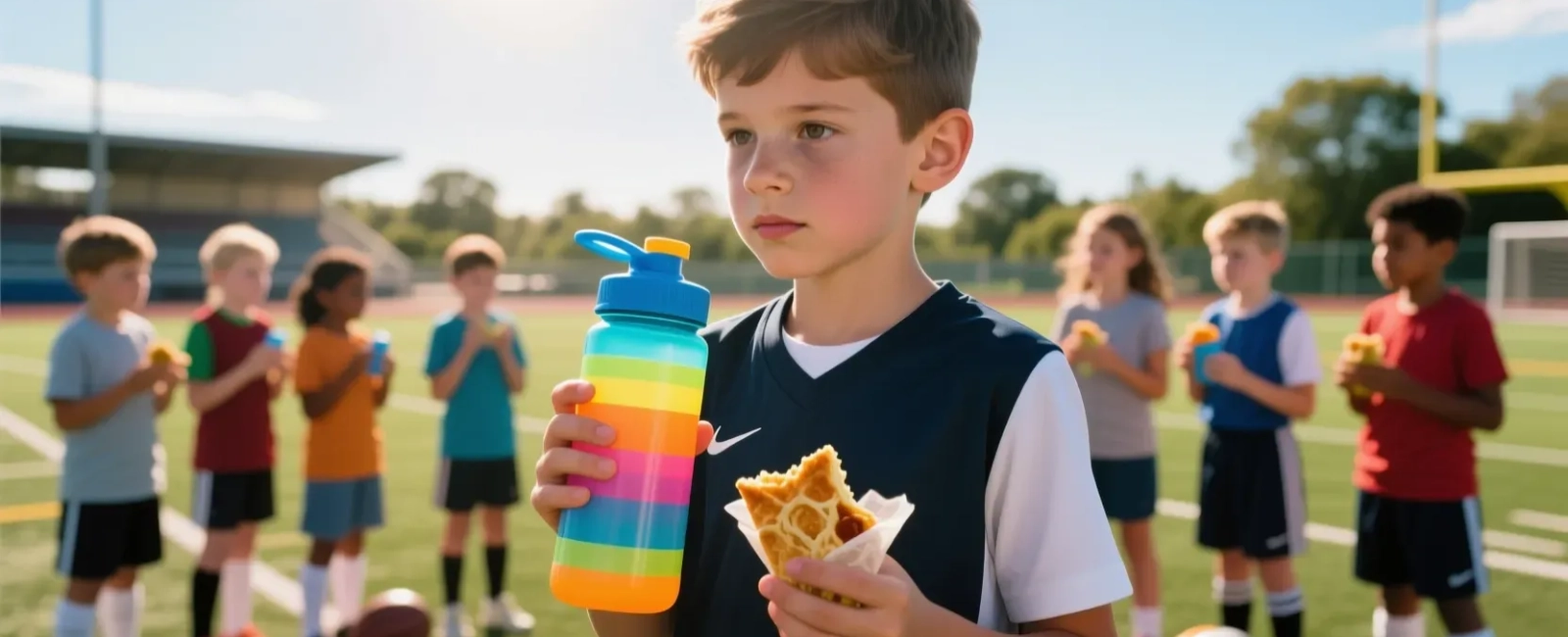
For Hydration: Think “Sip, Don’t Gulp.” Make the water bottle a constant companion, not an emergency tool. Get a decent one they like carrying. Encourage consistent sips all day. For long game days or tournaments, consider splitting the job. Use water for the first half, and if they’re going hard and sweating buckets, switch to a properly formulated sports drink for the second half to replace what’s being lost. The scoping review pointed out something critical: overdoing it is a real danger too. Gulping down a huge amount of fluid too fast can be just as bad as not drinking enough. It’s about steady intake.
For Snacks: Think “Balance, Not Buzz.” Skip the flashy, sugary packages. Look at the snack as a way to bridge the gap between meals. If the game is in an hour, go for something easily digestible (like the banana example). If you have two or three hours, you can include a bit more, like a small turkey sandwich. The color of the snack is a decent clue—beige, packaged bars often aren’t as great as something with a natural color you can recognize.
The Best Gauge You Already Have: Pay Attention. Forget complicated charts. After practice or a game, take a quick look at their urine. It should be a light lemonade color, not a dark apple juice. That’s the simplest, most effective biomarker you’ve got. And just ask them how they felt. Did they fade in the last quarter? Did they get a headache? That’s useful data for next time.
Wrapping your head around this changes the game. It moves you from being a passive observer to an active part of their setup. You’re not just a shuttle service; you’re the pit crew making sure the fluid levels are optimal and the fuel is clean. It’s one less variable they have to worry about, so they can just go out and play. And seeing them finish strong, with energy left in the tank, that’s the whole point, isn’t it?
